


And when they don't, even small disconnects can create friction. Patients repeat information, providers lack clinical context, and operational bottlenecks become harder to identify.
A connected technology stack supports every stage of the patient journey while giving operators the visibility, efficiency, and flexibility they need to scale. The sections below walk through the key decisions that shape a modern telehealth technology stack, from clinical systems and patient communications to payments, integrations, and analytics.
Key Decisions That Shape Your Technology Stack
Choose the Right Clinical Systems
Your electronic health record (EHR) or electronic medical record (EMR) is the clinical backbone of your telehealth business. It stores patient records, provider documentation, treatment history, and other essential clinical data.
When evaluating clinical systems, look beyond core functionality. A platform that doesn't integrate well with the rest of your technology stack can create siloed patient data, duplicate work, and a fragmented experience for both providers and patients.
Consider:
- Specialty fit and clinical workflows
- Integration capabilities
- Scalability as patient volume grows
- Documentation and reporting needs
Connecting the Patient Journey
Patients shouldn't feel like they're moving between disconnected systems as they progress from intake to treatment and follow-up.
Customer relationship management (CRM) platforms, scheduling tools, and patient communications should work together to support a seamless experience before, during, and after care.
Think about how your technology will support:
- Patient onboarding
- Appointment scheduling
- Email and SMS communications
- Refill reminders
- Retention and re-engagement campaigns
As more communication tools are added, it's important to avoid fragmented workflows that create inconsistent patient experiences or unnecessary manual work.
Integrate Clinical Operations
Beyond the initial appointment, clinical care involves pharmacy, laboratory, and payment systems. They each play an important role in delivering a smooth patient experience.
Strong integrations can automate:
- Telehealth payment processing
- Healthcare subscription billing
- Prescription routing
- Lab ordering and results delivery
- Failed payment recovery
- Telehealth chargeback management
- HSA/FSA payment acceptance
Because these systems exchange sensitive clinical and financial information, operators should prioritize security, reliability, and compliance when selecting technology partners.
Payment infrastructure is more than a checkout experience—it supports recurring care models, subscription billing, refill continuity, and long-term patient retention.
Build for Measurement and Scale From Day One
Growth becomes much easier when your technology stack provides clear visibility into business performance.
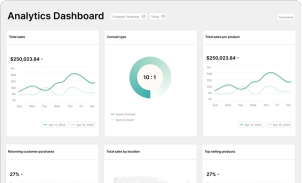
Analytics tools help operators understand what's driving patient acquisition, retention, adherence, and revenue while identifying opportunities for improvement.
Look for reporting that includes:
- Patient acquisition cost (PAC)
- Lifetime value (LTV)
- Conversion rates
- Treatment adherence
- Revenue by product, geography, or referral source
Building analytics into your infrastructure early makes it easier to identify operational bottlenecks, monitor growth, and make data-informed decisions as your business scales.
Decide Whether to Build or Buy
One of the biggest technology decisions telehealth operators face is whether to build custom integrations internally or rely on pre-built infrastructure.
Building custom APIs offers greater flexibility but often requires dedicated engineering resources, longer implementation timelines, and ongoing maintenance. As organizations grow, managing multiple vendors and custom integrations can also become increasingly complex–and expose businesses to greater security risk.
Pre-built infrastructure can reduce operational burden and help teams launch faster.
Here are some questions to consider as you weigh the pros and cons of each approach:
- Which systems do we already use?
- Which integrations are essential at launch?
- How much engineering support do we have internally?
- Are we optimizing for flexibility, speed, or both?
The right approach depends on your team's resources, timeline, and long-term growth goals.
How CareValidate Approaches Technology Stacks and Integrations
CareValidate is designed to work with your existing technology stack, not replace it.
Its API-first architecture connects providers, patients, pharmacies, laboratories, payments, and analytics into one centralized care ecosystem, giving operators the flexibility to build around the systems they already use.
Connect Your Existing Systems
CareValidate's full REST API allows teams to integrate core business functions—including patients, providers, encounters, orders, billing, and payment workflows—into custom operational workflows.
Operators can also subscribe to real-time webhook events, such as completed appointments, processed payments, prescription fulfillment, and lab results, allowing downstream systems to update automatically without manual intervention.
For teams building custom integrations, a dedicated developer sandbox provides a secure environment to test and validate workflows before deployment.
Launch Faster with Pre-Built Integrations
For operators who don't want to build every connection from scratch, CareValidate offers pre-built integrations across the most common telehealth systems, including Surescripts, Stripe, NMI, Twilio, SendGrid, Zoom, Daily.co, Customer.io, Everflow, Google Analytics, and Looker.
This helps teams connect clinical, operational, and marketing systems more quickly while reducing engineering overhead.
Integrated Payments and Operational Visibility
CareValidate manages the full payment lifecycle—from the first patient checkout through recurring subscription billing—within the same platform.
Operators can support flexible checkout experiences, healthcare subscription billing, HSA/FSA payments, fraud detection, and chargeback management without relying on separate payment vendors. Real-time financial reporting provides visibility into transactions, payouts, refunds, and recurring revenue, helping teams better understand both financial and operational performance.
Security and Compliance by Design
Every integration is supported by enterprise-grade security controls designed for healthcare, including SOC 2 Type II certification, HIPAA Business Associate Agreement (BAA) availability, TLS 1.3 encryption in transit, AES-256 encryption at rest, role-based access controls, and comprehensive audit logging.
Together, these capabilities help operators build connected, secure, and scalable technology infrastructure from day one.